Eng
During Women’s Month, we talk a lot about women’s strength, but it is important to remember that they are also the ones who carry the responsibility of taking care of everything, often without a support network. This care, whether for children, a family member or household chores, takes up a great deal of women’s time, as they make up the majority of those responsible for these activities.
In 2022 alone, women spent almost twice as many hours per week as men on unpaid domestic and care work. And there is an aggravating factor: the lower their income, the more time they devote to this work. These figures were released by DataCuidados and reveal the overload women carry and the gender inequality involved.
In this context, the National Care Policy was created in 2024, with the aim of recognizing care as essential work for the sustainability of life, the economy and society itself. The goal is to make visible what has historically been treated as women’s private responsibility and to seek solutions to reduce this overload.
The Policy, established by Law No. 15,069, was developed with the participation of government bodies from different areas and strong influence from civil society organizations that, like Instituto C, see up close how much care has consumed women’s lives. It guarantees everyone the right to care (understood as the right to care for others, to be cared for and to self-care) and determines that the State must implement the Policy gradually and progressively through a National Care Plan, called Brasil que Cuida (Caring Brazil).
The impact of the care overload
Also according to data from the 2022 Continuous National Household Sample Survey (PNAD-C), over the course of the year, Black women spend around 72.8 more hours on care than white women. This shows how much race, in addition to gender, still directly affects the lives of those dedicated to caregiving.
Just by looking at the number of hours women devote to care, it is already possible to infer that they cannot reconcile this routine with paid work. This lack of time also affects the course of women’s lives, reducing their chances of completing their education and preventing self-care, leisure and participation in public life, among many other areas.
How does the Policy work in practice?
Brasil que Cuida is the instrument for implementing the National Care Policy, promoting policies, services and programs so that the law is actually put into practice across different sectors. The goal is to reduce inequalities of gender, race, class, age, territory and disability in care work, and to promote the recognition and appreciation of care as essential work.
Even before the law, the country already had public care policies for the population, whether through daycare centers, health services or shelter programs. The problem is that they were built in a fragmented way, each within its own specific area.
Now, the challenge is to integrate them, as Nayara Oliveira, IC’s institutional development coordinator, explains: “They were not originally designed as part of a structured care policy. That is why they often operate in a disconnected way and still cannot fully reach everyone who needs support in their daily lives.”
According to the plan released by the Federal Government, the investment planned for 2024 to 2027 is organized into five main pillars:
- Guaranteeing rights and promoting policies for those who need care and for those who provide unpaid care;
- Reconciling paid work, education and family care needs;
- Decent work for domestic workers and paid care workers;
- Recognizing and valuing care work in its many forms and driving cultural change toward a fairer social organization of care;
- Governance and management of the National Care Plan.
Among the projects scheduled to take place by next year — some of which have already begun — are public laundries to reduce the domestic workload, with community spaces integrated with cultural and training activities; cuidotecas, spaces for welcoming and caring for children at universities, federal institutes and municipalities; places in daycare centers, preschools and full-time schools for families headed by women; and the Mulheres Mil + Cuidados program, which offers professional training in care for women in vulnerable situations, with a focus on domestic workers and caregivers.
By redistributing care among the State, families and society, these policies help address the gender, race and class inequalities present in the social organization of care,” says Nayara.
Why is care even in our name?
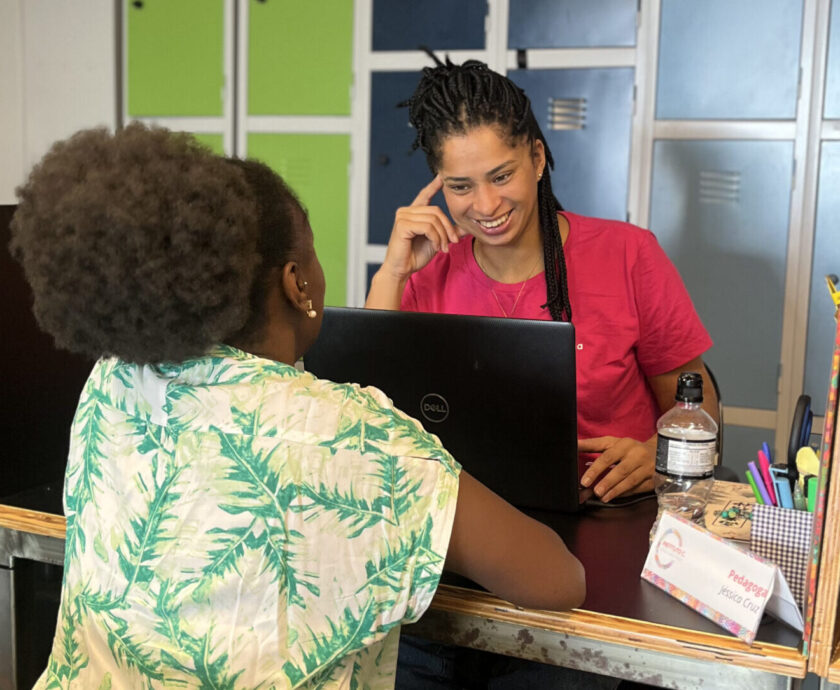
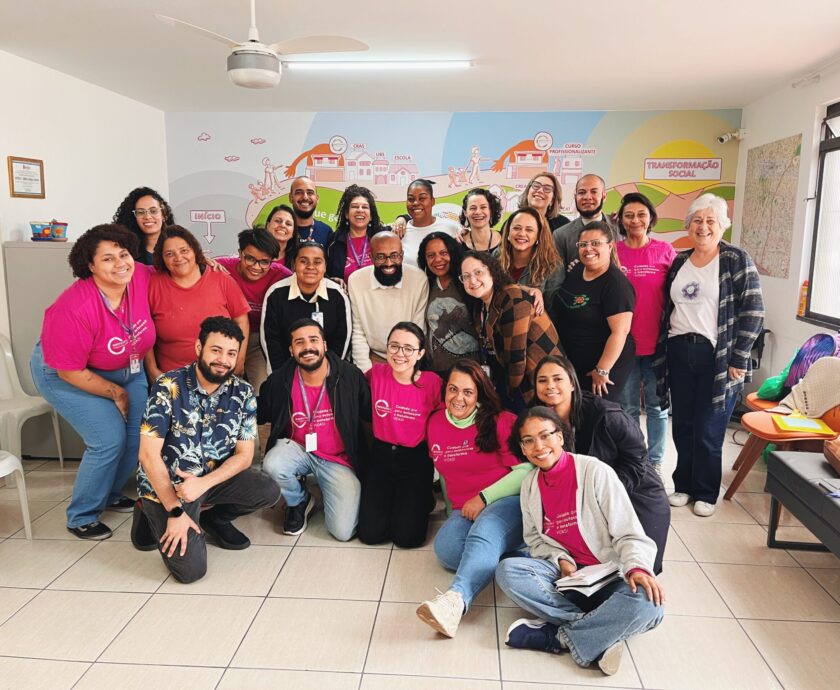
At Instituto C, we serve many families that are mostly headed by women, who are also the main providers of care, and we seek to support them in accessing rights, public services and support networks in their territories. In this way, we recognize that our work is also part of the field of care policies.
For Nayara, this work also serves as a bridge to help families live with more dignity. “By strengthening these caregivers and expanding their access to rights, Instituto C also helps them have better conditions to carry out their protective and caregiving role with dignity, while also putting self-care on the agenda as a right addressed within the policy,” she explains.
Talking about care policies is a duty of society as a whole, and it cannot be the responsibility of families alone, but also of the government. Strengthening those who provide care is also a way of ensuring the development and protection of those who receive it.