Eng
The end of the year arrives as a real breath of fresh air and a reminder that we should dream and renew our wishes for the next cycle. Dreaming is like fuel that keeps us believing life can bring us good things. But for those living in the peripheries, holding on to that outlook becomes harder when other worries stand in the way.
At Instituto C, we work together so that families on the peripheries can keep dreaming and also make those wishes come true. It is important that they do not merely survive amid the daily rush, but are also able to envision and achieve what they want, and with knowledge of their rights and guidance, that path becomes less winding.
Greater accessibility, the opportunity to study and owning their own property are part of many families’ dreams. With this in mind, and from the perspective of residents of São Paulo’s peripheries, Thais Gomes and Nicolie Barbosa, Design students at PUC-SP, set out to answer the question “what does it mean to dream in the periphery?” and spoke with mothers and children served at IC’s North Zone Hub, who moved us with every answer.
As residents of the periphery themselves, Thais and Nicolie have always lived the duality of resisting and dreaming amid chaos, which is how the idea of bringing this theme into their project came about. “Our idea for our final undergraduate project came from a conversation we had last year, in which we talked about how privileged we were to be able to dream despite the reality we grew up in, in the periphery — and how many people in the same reality don’t have that opportunity,” says Thais.
For Nicolie, who studies at PUC through the University for All Program (PROUNI), this was a way of giving the will to dream back to people living in peripheral areas. “I always say that the place where I was born, Capão Redondo, is a dream factory. We are a generation of dreamers who see hope beyond where we come from. I carry that hope with me, even in the face of the adversities I faced on my way to university,” she says.
What is it like to dream with your mind in many places?
Achieving a dream is a moment worth celebrating, but it means different things to each person. For many mothers, the dream has their children’s faces: more safety, education, health and opportunities they themselves never had. Even in moments when they can let their imagination run free in countless ways, they keep thinking of dreams that would bring good moments to everyone around them. And for many children, the dream is the window through which they see a world that goes beyond the narrow streets they know.
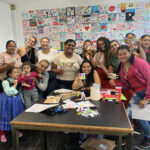
In the periphery, dreaming is not just an automatic everyday exercise. It is also something built piece by piece: cutouts of wishes and small victories. That is why the activity Thais and Nicolie proposed was for the families to make collages with images representing their dreams. There, imagination flowed, and cutouts appeared of trips, cars, motorcycles and even cures for illnesses that afflict their lives.
Faced with a heavy routine, this imaginary world is what helps sustain hope and creates new possibilities. Although it should not be this way, having time to dream sometimes becomes a privilege, and that is what strengthens families on different fronts: it helps them see paths where real life has not yet reached, builds self-esteem and places people at the center of their own story, and rebuilds a sense of the future, which is often worn down by a lack of opportunities.
Studying: a dream for children and adults alike

The busy routine of caring for their children means many mothers cannot find time to pursue their own dreams. When asked, many of them spoke about wanting to finish their studies and go to university, like Vilma, who shared that this is one of her dreams: “I really want to go to college, but I never had that little push. For me, it’s the biggest dream of my life.”
Through children’s eyes, dreaming also becomes a way of imagining a change of life for themselves and their families. They carry the desire to transform their reality through a profession, and fortunately some of them already know what makes their hearts beat faster: “saving lives. Being a doctor,” is Alan’s dream.
The right to dream
In childhood, imagination travels to the most diverse places; this is when the world becomes a place of infinite possibilities. But when limitations are imposed, it is as if a barrier were built between that child and everything they could still become.
Like Alan, many children dream of pursuing professions that make their eyes light up, but reaching those dreams is only possible when the conditions to achieve them exist. Quality education and a safe space to develop fully are the right of every child, and we must fight to make this a reality.
Adults also need this fuel to keep believing their wishes can come true. “I think it’s never too late to dream,” says Cristiane, showing that there is no right age for dreaming, and that all it takes are the possibilities and opportunities to make it real.
Dreams that inspire
Thais, who lives near Brasilândia, where our North Zone Hub is located, says that the exchange with the mothers and children was very enriching and broadened her perspective on dreaming, an act that, however simple, also changes realities. “For me, it was a truly transformative experience: being able to listen to other people’s stories, seeing how a dream is something simple and optimistic through children’s eyes, and how it also stays alive in the mothers,” she says.
Nicolie, in turn, recognizes that her dreams are also what drive hope, and that telling other people’s dreams is a way of seeing the reality of the peripheries from different perspectives. “It was moving to see how everyone looked up when they talked about dreams and how their eyes sparkled during the collages. The final video is just a small piece of what this experience was. The greatest impact lies in what the process brought to us and to those who took part in it,” the student recalls.
To learn more about Thais and Nicolie’s work and understand how dreams can be an important bridge for people living in the peripheries, click here and watch the full video with testimonials from some of the mothers and children served by IC.