
Eng
Do you remember the last time you had free time in your schedule, with nothing to do?
For many people, work takes up most of their time, demanding almost total mental and emotional effort. The overload of roles, inside and outside the home, piles up in their routine, especially in the lives of specific groups in society, such as single mothers living on the peripheries.
According to 2022 data from IBGE’s Continuous National Household Sample Survey (PNAD), women spend almost ten more hours per week than men on household chores: 21.3 hours for women and 11.7 hours for men. An analysis by Ipea based on the same microdata shows that the number of hours spent on domestic work can increase by up to ten hours for poorer women, with an even greater variation when we consider these women’s race.
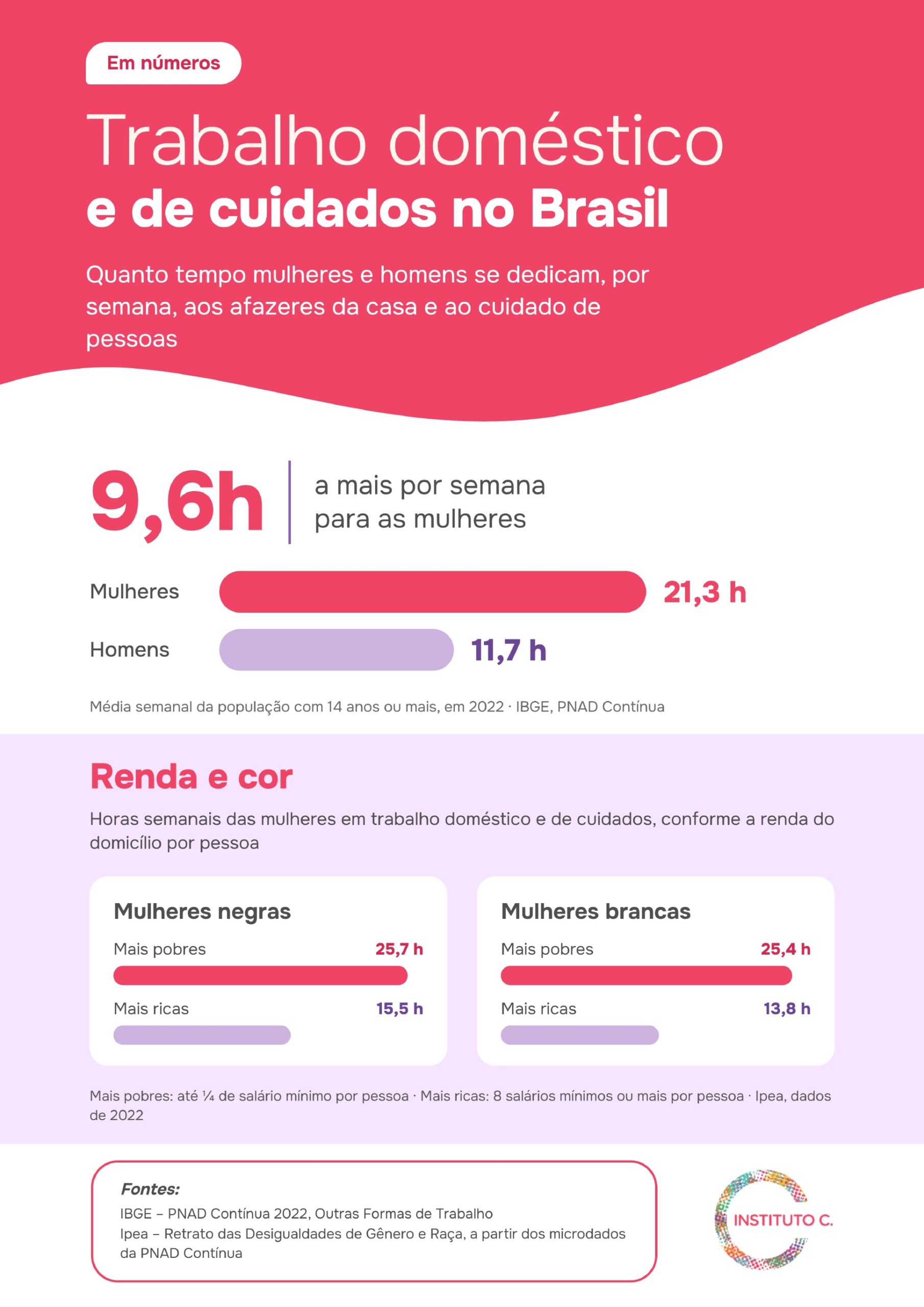
We can’t leave this out, because those who are rich have far more resources. There’s no way to compare, for example, a celebrity who has more than one nanny at home with the women supported by Instituto C, who often have no support network and therefore few opportunities to rest,” notes Camila Alves, a psychologist on the technical team at IC’s Porto Alegre Hub.
This accumulation of roles adds to caring for children, relatives and the other responsibilities of adult life, a task society keeps placing on women, causing their minds to enter a constant state of alert. In addition, because of the increasingly productivity-driven logic that persists in society, there is a feeling of guilt when doing nothing. “I notice that, especially for people from lower-income backgrounds, there’s this guilt about idleness, you know? As if the person could be doing something productive that would bring in money,” the psychologist comments.
Rest is a basic right
It is no coincidence that Brazil is the fifth most stressed country in the world, according to the 2025 Health Service Report by Ipsos. In the survey, 70% of Brazilians reported having felt so stressed in the previous year that they were unable (once or several times) to cope with their responsibilities. In countries such as Japan, at the bottom of the ranking, this percentage drops to 38%.
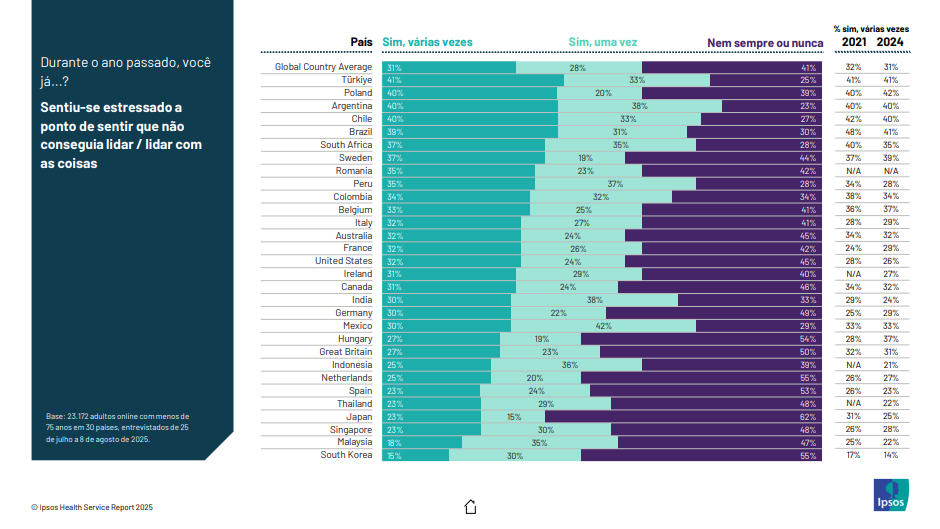
From a physiological point of view, the solution to accumulated stress should be simple: a person just needs to rest, finding pleasant pastimes for the mind and relaxing the body. This is a basic right, even provided for by law in our country. In Articles 6 and 7, the Federal Constitution clearly states that every Brazilian has the right to leisure and, if employed, must have weekly time off to rest.
According to the rules of labor law, employment must not cause workers existential harm, that is, harm that affects their social and family life and their leisure time. Precisely for this reason, in May, an update to Regulatory Standard No. 1 (NR-1) — which sets out workplace safety guidelines in Brazil — added psychosocial risks as an occupational risk subject to inspection. In other words, guaranteeing rest is no longer a courtesy from the company; it has become a legal obligation.
The importance of self-care and mental health
But in practice, we know this is not how things happen, and even unemployed people, when they lack a support network, become so overburdened that they go into autopilot, leaving any self-care practices behind. This is an alarming feature of our society that deserves everyone’s attention. We need to demand that governments and employers provide basic conditions for rest and leisure for everyone, because this is a public health issue.
That is what Henrique Akiba, a psychologist with a PhD in neuroscience from USP and a consultant at Instituto Ame Sua Mente, advocates. The institute focuses on promoting a culture of mental health care, with education as its strategic pillar: training teachers so that Brazilian children grow up aware of their responsibility for the health of their own minds. According to the Institute, Brazil needs to find ways to prioritize mental health in every sphere, by raising awareness in society and building cross-cutting public policies.
Resting the mind shouldn’t be just a luxury. Just as these mothers commit to caring for their children, we need to understand that the responsibility for self-care is just as important as caring for the family,” warns Henrique.
Unfortunately, the way society is organized takes rest out of the position of a basic right and turns it into a privilege. In IC’s sessions, Camila says it is very common to meet mothers who barely know what it is like to have a light routine. “Even when we ask a woman whether she has these moments of rest, there’s that laugh, as if to say: ‘Oh, you’re talking about something that’s impossible for me.’ That’s because the lack of a support network and of a slightly more stable financial situation rules out the possibility of rest.”
What happens to a body that doesn’t rest?
When we don’t rest properly, our mind holds on to accumulated stress, like smoke building up inside a broken-down car. And since our body is a single whole, this ends up affecting us entirely, bringing pain, skin irritation, and cognitive, behavioral and socioemotional difficulties. Not to mention, of course, a series of mental health issues, such as depression, anxiety disorders and burnout. “The person starts having difficulty making decisions and regulating their emotions,” adds Henrique.
At some point, the bill comes due, because there’s no way around it, right? We’re not machines. The body keeps sending signals that it needs to de-stress, because it’s much harder to rest the mind than the rest of the body. Because even when you lie down, your mind keeps working,” says the Instituto C psychologist.
Make time for leisure, even if brief
According to Henrique, there are differences between more passive moments of rest, such as watching TV or scrolling on your phone, and pleasurable activities that exercise the mind and body. And both are very important! “Sometimes lying down isn’t enough to recover from more severe exhaustion,” he says. Leisure, then, emerges as a very rich way of caring for the mind and reducing stress levels. You can:
- Do simple physical activities, such as walking for a few minutes or taking the stairs;
- Read a book;
- Do word searches or another hands-on activity;
- Chat with your neighbors;
- Take part in communities every week, whether religious or not;
- Take three-minute breaks throughout the day to close your eyes and breathe;
- Take a slightly longer shower;
- Put lotion on your body;
- Eat a full meal sitting down, chewing properly.
These are some of the possible ways to bring pleasure into life, even amid so many demands. After all, we cannot allow rest to be a privilege guaranteed only to the wealthiest.
We know that overload is a reality and that there’s often no support network. But what can be done within the routine to bring in a little more rest and avoid this collapse?” reflects Camila.